Thank you to everyone reaching out!
Many, many organizations, nonprofits and interest associations have reached out and I am trying to respond to all! When survey results are published I will try to link here for everyone.
If the issue is important to you, it is important to me. Please stay in touch, and all the best!
Sincerely,
Harjas
Links: www.crddoggsociety.ca | Harjas Singh Popli
1. Are you familiar with the lingering issues created by the People, Pets and Parks Strategy in Saanich?
Yes. I have familiarized myself with the People, Pets and Parks Strategy and, importantly, I have been listening to residents with different perspectives on its implementation. I understand why Saanich wanted clearer rules, protection for environmentally sensitive areas, and parks that are welcoming to dog owners and non-dog owners alike. At the same time, the implementation has left some residents feeling that reasonable leash-optional access has been significantly reduced and that their concerns were not adequately reflected in subsequent decisions. For me, this is not simply a debate between dog owners and non-dog owners. It is also a question of good governance: whether decisions are evidence-based, whether consultation is meaningful, whether compromises are respected, and whether public money is being spent effectively. I believe Saanich should be able to protect sensitive areas while still providing reasonable recreational opportunities for responsible dog owners.
2. Has the People, Pets and Parks (PPP) initiative been effective so far? Why or why not?
I think the answer is mixed. There are positive objectives within the strategy. Clearer signage, education about responsible pet ownership, better waste management, protecting sensitive ecosystems, and providing spaces where residents can enjoy parks without encountering off-leash dogs are all reasonable objectives. However, effectiveness should be measured by outcomes, not simply by whether regulations, signs or fences have been installed. We should be asking: Have conflicts decreased? Has compliance improved? Are environmentally sensitive areas actually recovering? Are residents satisfied with the available options? Have we provided sufficient and practical leash-optional opportunities? And are the results proportionate to what taxpayers are spending? The PPP Strategy itself recognizes the importance of monitoring and evaluation. I believe Council should review that evidence openly and be prepared to adjust the program where the results do not justify the approach being taken.
3. What aspects of the PPP, if any, do you think need to change?
I would like to see the PPP become more adaptive, evidence-based and collaborative. First, Saanich should regularly review leash restrictions and leash-optional areas using actual data on environmental impacts, complaints, safety incidents, park usage and compliance rather than treating every initial decision as permanent. Second, we need meaningful leash-optional opportunities distributed reasonably across Saanich. Responsible dog owners are also legitimate users of our public park system. Third, I would put greater emphasis on education, responsible behaviour and targeted enforcement. A small number of irresponsible users should not automatically determine policy for everyone else. Finally, when residents and stakeholder groups participate in lengthy consultation processes and work toward compromises, Council should clearly explain how that input affected the final decision, especially if Council subsequently changes direction. Environmental protection and recreational access do not always have to be competing objectives. Good planning should try to achieve both.
4. How do you see Saanich supporting education programs related to park, beach and trail etiquette?
Education should be one of our primary tools. I would support practical, visible education around responsible dog ownership and sharedspace etiquette: keeping dogs under control, recalling or leashing a dog when appropriate, respecting people who do not want contact with dogs, keeping dogs away from protected areas, picking up waste, respecting seasonal restrictions and understanding trail etiquette. This should include clear and consistent signage, online information, community events and outreach in parks. Saanich can also work with organizations representing dog owners, environmental stewardship groups, neighbourhood associations and other park users to develop information that people will actually understand and follow. Education should be paired with fair enforcement for repeated or serious violations. My preference is to achieve voluntary compliance wherever possible and reserve stronger enforcement for situations where education and reasonable warnings are not working.
5. Is the $1.7M taxpayer funding allocated to the PPP the best use of those funds for Saanich? Why or why not?
I would want to see a clear accounting of exactly what is included in that figure before accepting the premise that $1.7 million has been allocated exclusively to PPP. More broadly, however, my position is consistent: every significant municipal expenditure should demonstrate need, measurable results and value for taxpayers. Some PPP expenditures, such as necessary signage, education, waste management, environmental protection and appropriately located amenities, may provide good public value. But that does not mean every proposed expenditure should automatically proceed simply because it falls under an approved strategy. With residents and businesses facing increasing costs, Council has a responsibility to scrutinize spending carefully. I would want to know what outcomes have already been achieved, what alternatives were considered, what further spending is actually necessary, and whether the same objectives could be achieved more efficiently. Responsible spending does not mean eliminating services. It means asking whether we are getting the best results for every public dollar.
6. Are you familiar with the fencing added to PKOLS this year?
Yes. I am familiar with the fencing installed along leash-optional trails at PKOLS and with the concerns that have been raised both about environmental protection and about the extent, cost and design of the fencing. I respect the importance of protecting the sensitive ecosystems at PKOLS. At the same time, any major intervention in one of Saanich’s most valued natural parks should have clearly identified objectives, evidence supporting the intervention and a way to measure whether it is actually working.
6(a). Do you support spending a further $270,000 to fully enclose the 1.7 km off-leash trail at PKOLS? Why or why not?
Before committing a further $270,000, I would want Council to demonstrate why full enclosure is necessary and what evidence shows that it is the most effective and proportionate solution. I would want to review the monitoring data, environmental objectives, effectiveness of the fencing already installed, alternative approaches and ongoing maintenance costs. If specific sensitive areas require physical protection, we should protect them. But I do not believe Council should assume that more fencing is automatically the answer without first demonstrating the need and evaluating less costly or less intrusive alternatives such as targeted fencing, restoration, education, clearer boundaries and appropriate enforcement. That is the standard of fiscal responsibility I would apply to this expenditure as I would to other municipal spending.
7. In seeking to be elected, what do you stand for that you think would be important for our members to know about?
I believe good local government starts with listening. My campaign is focused on responsible spending, affordable housing, safer and bettermaintained infrastructure, support for seniors, youth and families, and stronger transparency and public trust. But underlying all of these priorities is something equally important to me: residents should feel that their participation matters. As the founder of Fateh Care Charity, I have spent years working directly with people from very different backgrounds and circumstances. That experience has taught me that good solutions rarely come from listening to only one side. On issues such as parks and dogs, I do not believe Saanich needs to choose between environmental protection, people who prefer dog-free experiences and responsible dog owners. We should protect genuinely sensitive areas, provide reasonable leash-optional opportunities, expect responsible behaviour from dog owners, educate before unnecessarily restricting, and make decisions based on evidence. My commitment is to be approachable, available and willing to listen, even when people disagree, and to make decisions with both community impact and taxpayer value in mind.
Regards, Harjas
Links: Vote4Tomorrow | Harjas Singh Popli
(Due to the section lengths it may be easier to navigate to the website! Direct link above.)


Climate action
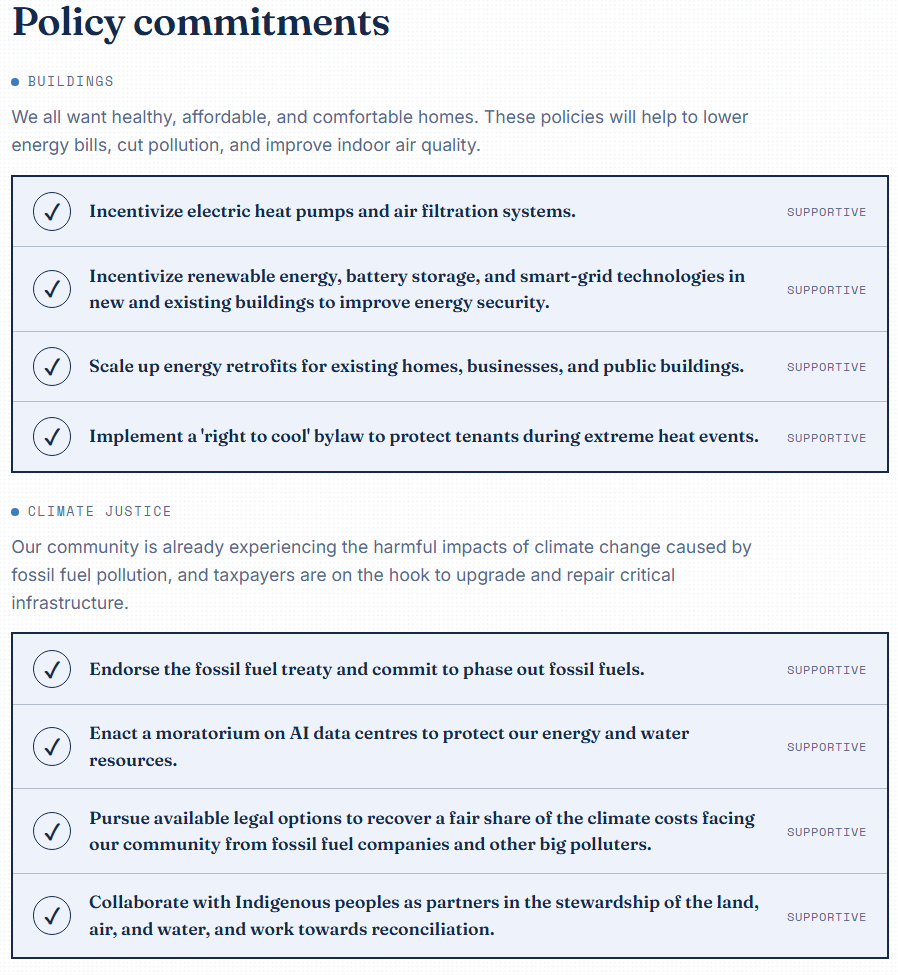
How have you contributed to climate action in your community through advocacy, past work, advisory committees, volunteer work, and/or reducing your personal carbon footprint?
My family and I have been driving electric vehicles for many years, and try to reduce our carbon footprint with energy efficient appliances and smart thermostats. Outside of the home, I have supported recycling and waste reduction in my capacity as an HR professional, and support climate action as the risks described about climate change increasingly come to pass.
Worse than that, missed opportunities delay solving the problems and create further downstream. Deteriorating relationships between governments at all levels as well as with those they are entrusted to be responsible. Climate inaction has all manner of costs. Lives are lost the more disconnected from each other we are. Shocking tragedies in Nepal or the evacuations and heat deaths in Europe are from the same science that applies here in BC. Thinking longer-term on climate includes linking our personal and collective actions towards measurable outcomes and positive impacts for ourselves and others.
Questions for Saanich
What are your top priorities for the next 4 years to address climate and environmental goals in Saanich?
What I am hearing from people is a curiosity for understanding Saanich’s finances. I think generally that getting on the same page helps shape the next steps. Can we use this curiosity as an opportunity to start structuring a wider dialogue?
There are many things in the near and long-term that will incur costs and we all have a say to decide how distributed, fair, and intense those costs will be. That helps inform next steps.
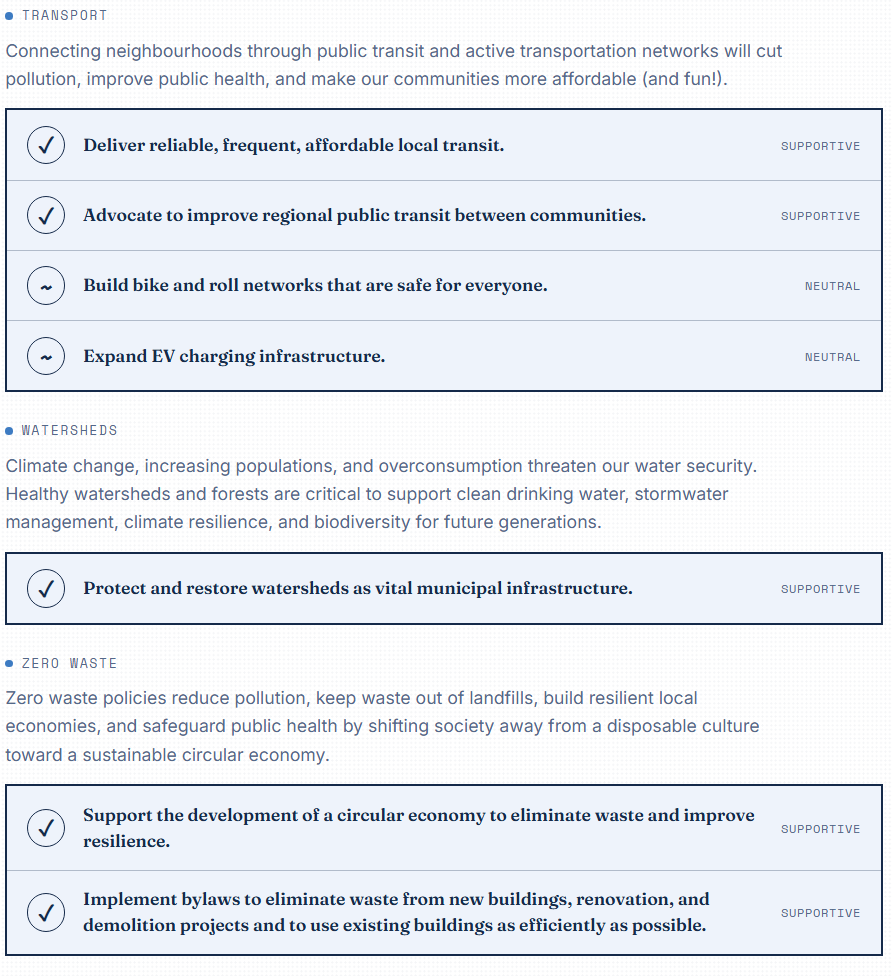
At the Saanich level as nearly everywhere else the current infrastructure cannot withstand an increasing pace of alternating heat domes and atmospheric rivers. They are happening more years than not. Baked soil becomes water repellant, making flooding likelier and worse. It might cost to do something about that, both in land use and money. We should talk about what it costs and how distributed, fair, or intense it is.
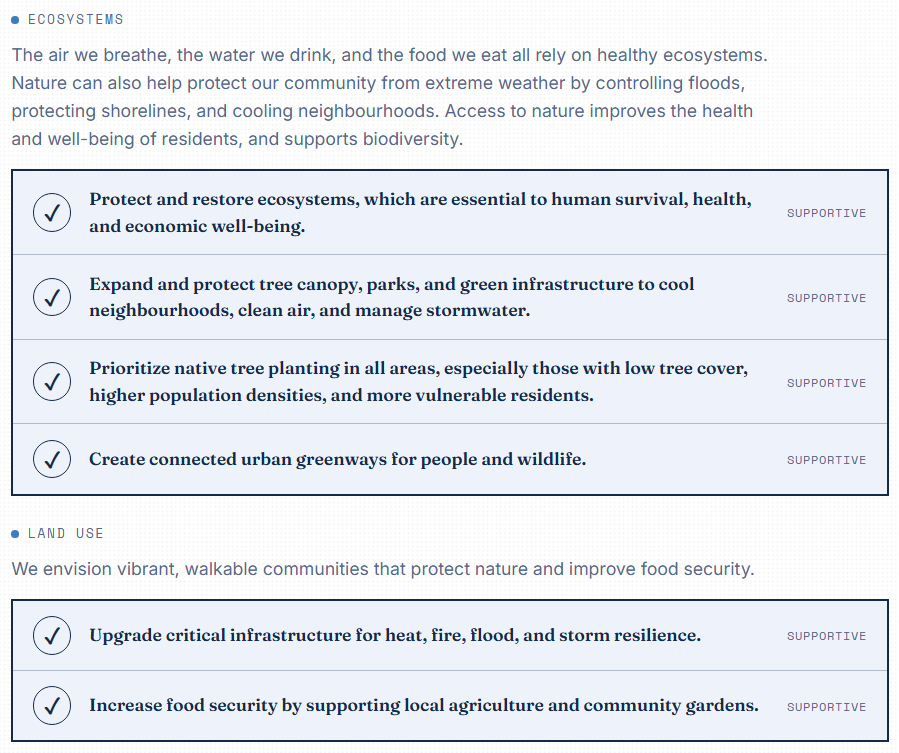
Other priorities include ensuring mature tree canopy, as cited in the BC Coroners Service report following the 2021 heat dome that areas with less canopy cooked in the sun and were an increased health risk.
Not acting also costs. The clean-up after the 2021 atmospheric river is about $4 billion, split between mainly Canada and BC.
Continuing the partnerships with regional, provincial and federal counterparts enable discussions about solution-costing and how distributed, fair, or intense they are. We must be transparent and promote these discussions and welcome more voices in building one Saanich.
How will you apply a climate lens to all your work with your fellow elected representatives, given competing priorities?
A climate lens to me means seeing things farther down the road headed for us whether we want to pay for it or not. Evidence and working through evidence deserves care, and understanding where others are coming from and relationship-building are not mutually exclusive, but might just be essential for speaking the same language about finding solutions to measurable challenges and risks.
Without further scenario-building I can only communicate my approach and my commitment on this is simple: listen, stay accessible, and work with others to build Saanich toward a better future. I believe welcoming more transparency, more leaning in is good for a healthy democracy that can meaningfully address the future challenges whether we want them or not.
How will you provide leadership in moving Saanich towards meaningful climate action?
By not losing sight that there’s a backdrop to any one municipality’s competing priorities. We are all responsible for a better future, and I think being granted a seat at the table would give me greater insight to what is working well or not.
I heard that people often get engaged in local government when government gets it wrong, but that must change something when people engage in a reaction and frustration rather than come together to build together?
We may increasingly need government to get it right and that seems less likely to happen if we are are not building together. What opportunities the community has to stay meaningfully informed and when to contribute and how meaningful their contribution becomes is important to structure well so expectations are clearer and productive discussions are more likely.
There may not be a perfect system, but as one example I have supported participatory budgeting make democracy a practice rather than a reaction to a mistake or exclusion. That is one way neighbourhoods can be connected and contributing, seeing a local impact to a park or public space while staying informed on larger finances.
Leadership here is upholding others.
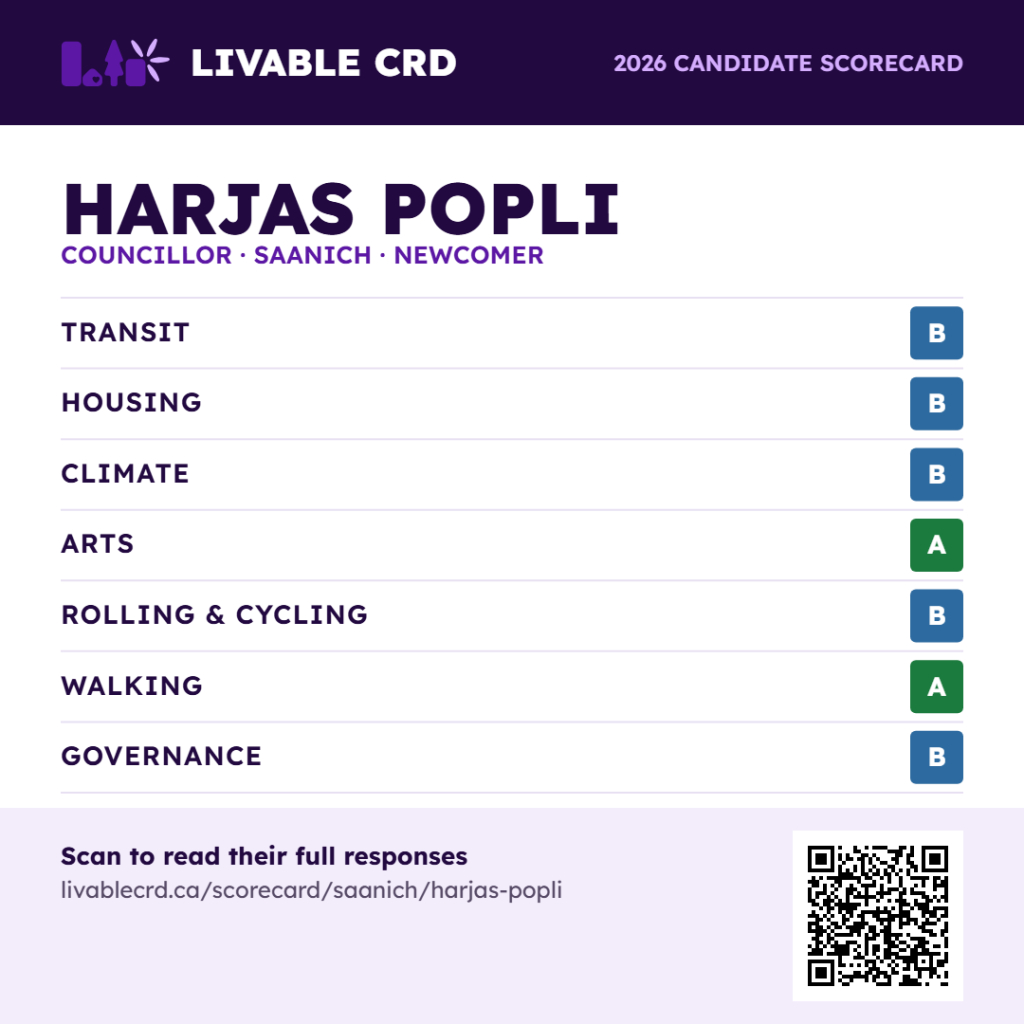
Links: Livable CRD – Saanich | Harjas Singh Popli Scorecard and Responses
(Due to the section lengths it may be easier to navigate to the website! Direct link above.)